
As beer production continues to expand, production efficiency, product quality, and operating costs have become key concerns for breweries. Traditional production methods rely heavily on manual operations, making production more dependent on workers’ experience and operating skills while increasing management complexity.
Brewery automation systems integrate PLCs, sensors, and production monitoring systems to connect different stages of production, including mashing, fermentation, CIP cleaning, and filling. This enables automatic process control, coordinated equipment operation, and real-time production monitoring.
Automation not only reduces manual labor but also helps optimize production processes, shorten equipment waiting times, and minimize production losses, improving the overall efficiency of the production line.
So, how does automation improve efficiency in different areas of a brewery?
Automated Brewhouse System
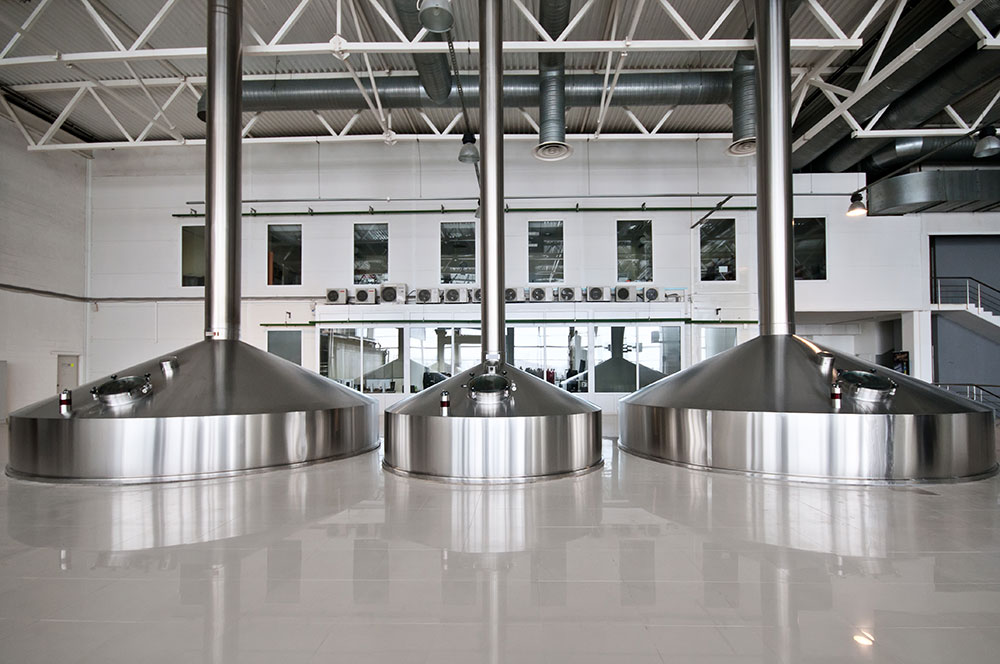
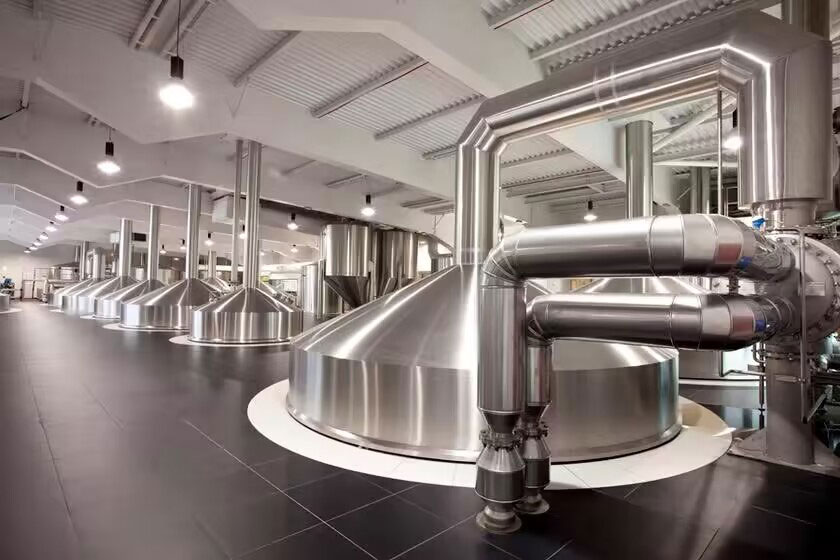
Brewing is the starting point of beer production. It mainly includes malt milling, mashing, lautering, sparging, wort boiling, and whirlpool separation. The efficiency of each stage directly affects the production capacity of the brewhouse.
Traditional brewhouse equipment often requires manual control of temperature, agitation, pumping, and valve switching. Delays in operation or poor coordination between processes can reduce production efficiency.
An automated brewhouse system uses PLC control to manage the entire brewing process. Operators can preset mashing temperatures, holding times, agitation speeds, and wort transfer sequences. The system then automatically performs the corresponding operations according to the brewing recipe.
Meanwhile, temperature, level, and flow sensors continuously monitor operating conditions, allowing operators to track the brewing process while reducing manual intervention and operating errors.
For breweries with multiple brewing batches per day, an automated brewhouse can improve coordination between different processes, reduce waiting times, and increase equipment utilization.
Automated Fermentation System
Fermentation is one of the longest stages in beer production. Parameters such as temperature and pressure directly affect yeast activity, fermentation progress, and the final beer flavor. Therefore, stable process control is essential.
Traditional fermentation management mainly relies on manual inspections and periodic adjustments. Managing multiple fermentation tanks in this way increases workloads and makes it more difficult to identify abnormal conditions promptly.
An automated fermentation system uses temperature sensors, pressure sensors, and PLC controls to monitor tank conditions in real time. Based on preset parameters, the system automatically controls cooling jackets, valves, and related equipment.
For example, when the tank temperature rises above the setpoint, the system can automatically adjust the supply of cooling media to maintain the fermentation temperature within the required range.
Operators can also monitor the temperature, pressure, and operating status of multiple fermentation tanks through a central control interface, making it easier to identify and address abnormal conditions.
This approach reduces manual inspection work and improves fermentation management efficiency and process consistency. However, automation does not replace the actual fermentation time. Its main purpose is to maintain stable fermentation conditions.
Automated CIP Cleaning System
Brewhouse equipment, fermentation tanks, bright beer tanks, and process pipelines require regular cleaning to remove wort, yeast, and other residues that could affect subsequent production and product hygiene.
Traditional manual cleaning requires considerable labor, and cleaning time, temperature, and operating procedures can vary depending on individual practices.
An automated CIP (Clean-in-Place) system uses PLC controls to operate cleaning pumps, valves, and cleaning sequences. It cleans the internal surfaces of tanks and process pipelines without dismantling the equipment.
A typical CIP cleaning process includes:
– Pre-rinsing: Removes residual product from equipment and pipelines.
– Caustic cleaning: Removes protein and organic residues.
– Intermediate rinsing: Flushes away residual caustic solution.
– Acid cleaning: Removes mineral deposits when required by the process.
– Final rinsing or sanitizing: Meets the hygiene requirements for subsequent production.
The specific cleaning sequence should be designed according to equipment type, contamination levels, and hygiene requirements.
An automated CIP system controls cleaning solution temperature, concentration, flow rate, and circulation time to ensure consistent cleaning conditions. Some systems can also recover and reuse cleaning solutions, reducing water and chemical consumption.
For breweries with multiple fermentation and storage tanks,properly planning CIP cleaning routes and schedules can reduce equipment downtime and improve production turnover.
Automated Filling and Packaging System
Filling and packaging are the final stages of beer production and play an important role in determining finished product output.
If the brewhouse and fermentation systems have high production capacities but the filling equipment cannot keep up, packaging can become a production bottleneck. This may result in finished beer accumulating or upstream equipment having to wait.
An automated filling and packaging system connects equipment such as container conveying, bottle washing, filling, capping, labeling, and packaging machines to achieve continuous production.
Depending on product types and packaging requirements, breweries can configure bottle, can, or keg filling equipment. Automated conveying systems coordinate the operating speeds of different machines.
In addition, automatic inspection systems can check filling levels, sealing quality, and packaging conditions to reduce defective products and improve packaging efficiency.
Matching filling speed with the upstream beer supply capacity helps minimize production line downtime and waiting times, ensuring smooth product delivery.
Centralized Control and Production Monitoring
In addition to automating individual machines and production processes, centralized production management is another important way to improve brewery efficiency.
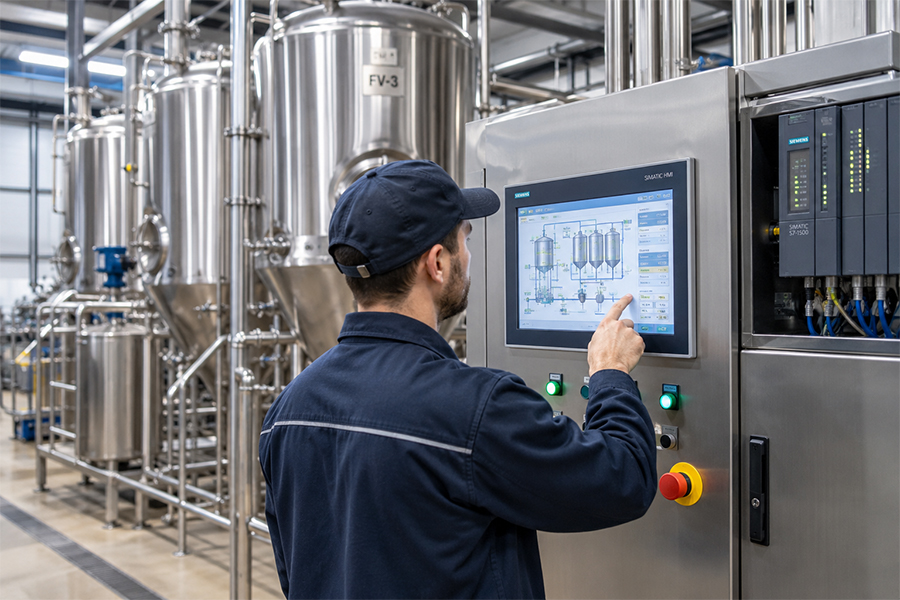
Modern breweries can use PLC, HMI, and SCADA systems to centrally manage brewhouse, fermentation, CIP, and filling equipment.
– PLC (Programmable Logic Controller): Executes equipment operations, process parameters, and automatic control programs.
– HMI (Human-Machine Interface): Provides operators with an interface for equipment operation and parameter monitoring.
– SCADA (Supervisory Control and Data Acquisition): Collects production data and provides equipment monitoring, alarm management, and historical data recording.
Through a central control interface, operators can monitor equipment status and key parameters such as temperature, pressure, liquid level, and flow rate. When abnormal conditions occur, the system can trigger alarms to help operators identify problems quickly.
The production system can also record process parameters and operating data for each batch, providing useful information for production analysis, process optimization, and equipment maintenance.
With centralized control, breweries can better coordinate different production stages and reduce production delays caused by communication problems or equipment failures.

How to Choose the Right Automation System for a Brewery?
The level of automation in a brewery does not necessarily need to be as high as possible. Instead, it should be planned according to production capacity, process requirements, equipment configuration, and investment budget.
For small craft breweries, it may be more practical to prioritize automatic mashing temperature control, fermentation tank temperature control, and basic CIP cleaning systems to automate the most important production processes.
For medium and large breweries, additional solutions can include automated brewhouse systems, centralized control of multiple fermentation tanks, automated CIP systems, and filling and packaging production lines. These systems help coordinate different production stages.
When planning a brewery automation system, several factors should also be considered:
Equipment Compatibility: Ensure that different machines and control systems can communicate and operate effectively together.
Production Capacity Matching: Configure equipment according to the capacities of the brewhouse, fermentation, and filling systems to avoid production bottlenecks.
Future Expansion: Reserve sufficient capacity and flexibility for adding equipment, increasing production, or upgrading control systems in the future.
Maintenance Management: Consider the maintenance requirements and troubleshooting of sensors, control systems, and operating equipment.
Proper automation planning helps avoid unnecessary equipment investment and resource waste, allowing breweries to achieve better production results from their automation systems.
The main value of brewery automation lies in improving overall production efficiency through equipment control, process optimization, and production data management.
For companies planning to build a new brewery or expand an existing facility, selecting suitable automation equipment and control systems based on actual production capacity and process requirements can help establish a more efficient and reliable beer production line.