
In commercial beer production, extending product shelf life, preserving beer flavor, and ensuring microbiological stability are important considerations for breweries. This is particularly true for bottled and canned beer intended for long-distance transportation, export markets, or supermarket distribution. Proper pasteurization helps reduce the risk of microbial contamination and product spoilage.
Beer pasteurization is a common heat treatment process that uses controlled temperatures and processing times to reduce the activity of spoilage microorganisms in beer. This helps improve microbiological stability and extend product shelf life.
Currently, two main pasteurization methods are widely used in commercial beer production: Tunnel Pasteurization and Flash Pasteurization.
The main difference between these two methods lies in when the treatment takes place. Tunnel pasteurization is performed after the beer has been filled and sealed in its packaging, while flash pasteurization treats the beer before filling. Each method is suitable for different packaging formats and production processes.
1. Tunnel Pasteurization
A tunnel pasteurizer is a continuous pasteurization system primarily used for bottled and canned beer. It is typically installed downstream of the filling and sealing equipment in a packaging production line.
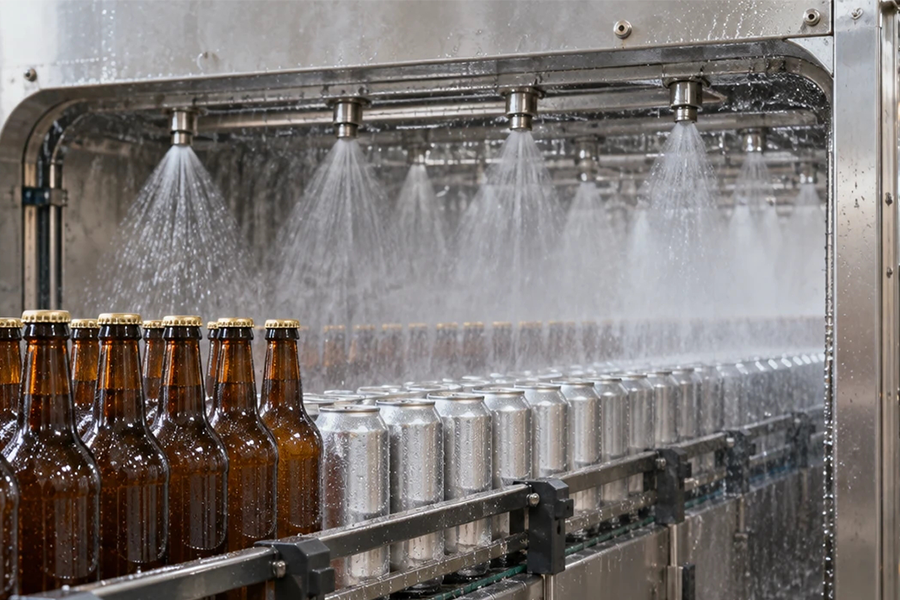
Its working principle is relatively straightforward. After the beer has been filled and sealed, the containers are conveyed through the tunnel pasteurizer on a conveyor belt. The machine sprays water at different temperatures onto the containers, gradually heating the beer to the required pasteurization temperature. The beer is then held at the target temperature for a specified period before being gradually cooled.
The entire process mainly consists of four stages:
Preheating Zone:Warm water is sprayed over the containers to gradually increase their temperature, preventing thermal shock caused by sudden temperature changes.
Heating Zone:The spray water temperature is further increased, allowing the beer inside the bottles or cans to gradually reach the target pasteurization temperature.
Holding Zone:The beer is maintained at the specified temperature for a certain period to achieve the required pasteurization units (PU).
Cooling Zone:Cooling water is sprayed over the containers to gradually reduce the beer temperature to a suitable level for labeling, packaging, storage, and transportation.
Through continuous treatment across multiple temperature-controlled zones, a tunnel pasteurizer provides heat treatment for beer inside sealed packaging.
1.1 Main Functions and Advantages
Pasteurization After Packaging: Treats sealed bottles and cans to reduce the risk of spoilage caused by microorganisms remaining inside the packaging.
Continuous Production: Uses a conveyor system for continuous operation and can be integrated with automatic filling, sealing, labeling, and packaging lines.
Adjustable Pasteurization Parameters: Pasteurization intensity can be adjusted by controlling spray water temperatures, processing times in each zone, and conveyor speed.
Reduced Risk of Secondary Contamination: Since pasteurization takes place after filling and sealing, the risk of microbial contamination from the external environment after treatment is reduced.
1.2 Applications in Beer Production
Tunnel pasteurization is mainly used for bottled and canned beer that has already been filled and sealed.
For breweries producing beer for long-distance transportation, export markets, or large retail distribution channels, tunnel pasteurization helps improve the microbiological stability of packaged products and extend their shelf life.
2. Flash Pasteurization
Flash pasteurization is a beer heat treatment process based on the High Temperature Short Time (HTST) principle.
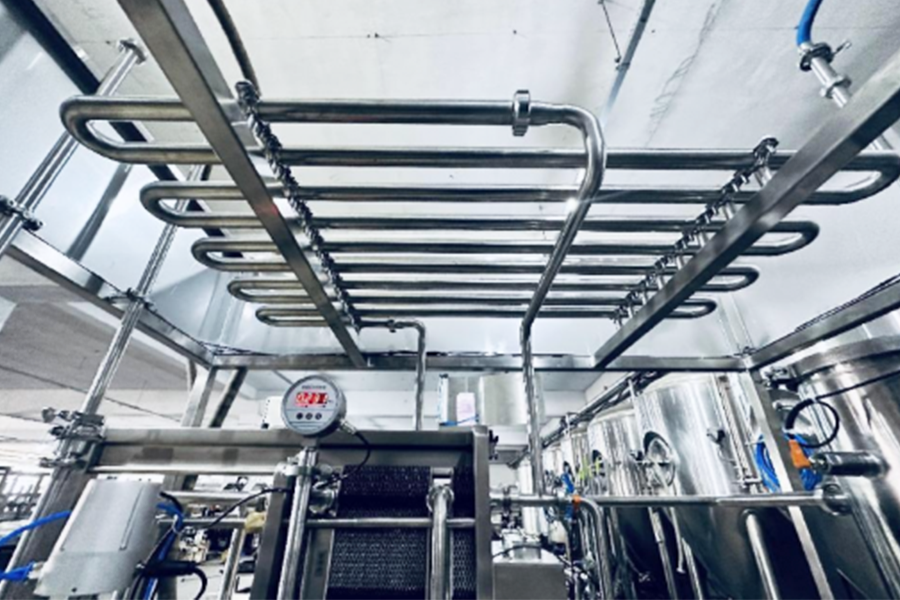
Unlike tunnel pasteurization, flash pasteurization takes place before beer filling. Beer flows through sanitary pipelines into the flash pasteurization system, where a plate heat exchanger rapidly raises its temperature. The beer is then held at the target temperature for a specified period before being rapidly cooled and transferred to the downstream filling system.
The main treatment process consists of four stages:
Preheating Stage:A heat recovery system uses the heat from previously pasteurized beer to preheat incoming cold beer, reducing the energy required for subsequent heating.
Heating Stage:A plate heat exchanger rapidly heats the beer to the specified pasteurization temperature.
Holding Stage:The beer passes through a holding tube, where it remains at the required temperature for a controlled period to achieve the target pasteurization intensity.
Cooling Stage:The beer is rapidly cooled through the heat exchange system and then transferred to the filling equipment through sanitary pipelines.
The entire process typically uses a high-temperature, short-time treatment method. The actual processing temperature and holding time depend on the target PU value, beer characteristics, and equipment design.
2.1 Main Functions and Advantages
High-Temperature, Short-Time Treatment: Completes heating, holding, and cooling within a relatively short period, making it suitable for continuous beer production.
Rapid Heat Exchange: Uses plate heat exchangers to achieve efficient heating and cooling, improving thermal processing efficiency.
Energy Savings Through Heat Recovery: Recovers heat from pasteurized beer to preheat incoming cold beer, reducing overall energy consumption.
Compact Equipment Design: Generally requires less floor space than a large tunnel pasteurizer, making it easier to integrate into a beer production line.
Precise Process Control: Allows operators to control beer flow rate, treatment temperature, and holding time, helping maintain consistent pasteurization results while avoiding unnecessary heat exposure.
2.2 Applications in Beer Production
Flash pasteurization is mainly used in continuous beer production lines. It can be applied to kegged beer as well as bottled and canned beer that requires pasteurization before filling.
Kegged beer is one of the typical applications of flash pasteurization. For bottled and canned beer, however, the system must be combined with an aseptic or appropriately designed high-hygiene filling system to prevent microbial recontamination during cooling, transfer, and filling.
For breweries looking to improve production efficiency, reduce equipment footprint, and maintain suitable hygienic filling conditions, flash pasteurization is a practical option worth considering.
3. Tunnel Pasteurization vs. Flash Pasteurization: Key Differences
| Comparison | Tunnel Pasteurization | Flash Pasteurization |
|---|---|---|
| Treatment Stage | After filling and sealing | Before filling |
| Working Principle | Sprays hot water over sealed containers for heating, holding, and cooling | Rapidly heats, holds, and cools beer before filling |
| Main Equipment | Tunnel pasteurizer | Plate heat exchanger, holding tube, and auxiliary systems |
| Suitable Packaging | Mainly bottles and cans | Kegs, bottles, and cans |
| Production Requirements | Suitable for integration with conventional filling lines | Requires high-hygiene or aseptic filling conditions |
| Main Characteristics | Pasteurizes the entire sealed package | Uses HTST treatment and generally has a more compact equipment design |
| Typical Applications | Continuous production lines with post-packaging pasteurization | Continuous production lines with pre-filling pasteurization |
4. How to Choose the Right Beer Pasteurization Equipment?
When selecting beer pasteurization equipment, breweries should consider more than just the purchase price. Production capacity, packaging formats, and process requirements should all be evaluated to determine the most suitable solution.
The following five factors are particularly important:
Production Capacity:Choose equipment based on hourly production output and filling speed to ensure that the pasteurization system matches the overall production line capacity.
Packaging Format:Select tunnel or flash pasteurization according to whether your beer is packaged in bottles, cans, or kegs.
Pasteurization Requirements:Determine the appropriate treatment temperature and PU value based on beer type, microbiological risks, and the desired shelf life.
Energy Consumption:Consider steam, electricity, and cooling water consumption. Equipment with heat recovery functions is worth prioritizing to improve energy efficiency.
Automation and Control:Choose a system that provides precise control over temperature, processing time, and PU values to ensure stable and reliable pasteurization performance.
Beer pasteurization is an important part of commercial beer production and packaging. Choosing the right pasteurization method helps improve product microbiological stability and meet different production requirements.
Tiantai Equipment provides production line planning and equipment configuration solutions based on customers’ production capacity, beer types, packaging formats, and facility conditions. Whether you are planning a new brewery or upgrading an existing production line, we can help you identify a suitable pasteurization solution for your business.