
In Part 1 of this series, we explored how oxygen management, yeast pitching, and natural circulation establish the conditions for healthy fermentation.
Once active fermentation is underway, however, another group of engineering factors begins to shape the final beer. The physical design of the fermenter—particularly its cone geometry, internal volume, and filling schedule—directly influences how yeast behaves throughout fermentation and how efficiently it can be recovered for future use.
For commercial breweries, these factors affect much more than yeast collection. They influence production scheduling, beer clarity, flavor consistency, and ultimately the operating cost of the brewery.
In this article, we examine why fermenter design should be considered an essential part of fermentation management rather than simply a vessel specification.
A Fermenter Does More Than Hold Beer
When discussing brewery expansion, fermentation tanks are often selected according to one simple criterion: capacity.
While tank volume is obviously important, experienced brewery designers rarely begin with liters or barrels. Instead, they first evaluate how the vessel will support the biological behavior of yeast throughout the entire fermentation cycle.
Inside every cylindroconical fermenter, yeast continuously transitions through different physiological stages. Immediately after pitching, cells remain highly active and reproduce rapidly. As fermentable sugars decrease, reproduction slows, cell metabolism changes, and yeast gradually begins preparing for sedimentation.
These biological changes occur regardless of brewery size, but vessel design determines how efficiently the process unfolds. For this reason, fermenter geometry should be viewed as an active participant in fermentation rather than passive equipment.
Why Cone Geometry Determines Yeast Recovery
One of the greatest advantages of modern cylindroconical fermenters is their ability to separate yeast naturally.
Unlike traditional flat-bottom vessels that often require additional handling to recover yeast, conical fermenters guide suspended solids toward a single collection point through gravity alone. Although the concept appears straightforward, successful yeast separation depends on several interacting factors. Yeast cells begin settling only after fermentation activity decreases sufficiently for convection currents to weaken. At the same time, brewing yeast increases its tendency to flocculate, forming larger clusters that settle considerably faster than individual cells. The cone acts as a collection chamber where these flocs gradually accumulate while clarified beer remains above.
The efficiency of this process depends heavily on the cone angle. Commercial brewery fermenters commonly employ cone angles between 60° and 70°, allowing yeast to slide smoothly toward the outlet while minimizing accumulation along the vessel wall.
If the cone is too shallow, compacted yeast may remain attached to the surface. If it is too steep, manufacturing complexity increases without providing proportional process benefits. This explains why most industrial brewery fermenters adopt similar geometric proportions despite differences in overall capacity.
Good cone design improves far more than harvesting convenience. It reduces beer losses during cropping, minimizes disturbance of settled yeast, and allows breweries to recover healthier yeast for subsequent fermentation cycles.
For breweries practicing serial repitching, these advantages quickly translate into improved fermentation consistency and lower operating costs.
Why Healthy Yeast Recovery Matters
Many breweries reuse yeast through multiple production cycles. This practice reduces ingredient costs while maintaining fermentation performance, provided the harvested yeast remains healthy and free from excessive trub contamination.
Poor yeast harvesting rarely causes immediate production failures. Instead, problems usually appear gradually.
- Fermentation becomes slightly less predictable.
- Lag times increase.
- Attenuation becomes less consistent.
- Off-flavors appear more frequently.
- Beer clarification requires additional effort.
Although each issue may seem minor individually, together they increase production variability over time. This is why experienced brewers place significant emphasis on yeast management rather than viewing harvesting as a routine cleaning operation.
The first material discharged from the cone typically contains the highest concentration of cold break, hop particles, and non-viable yeast. Removing this initial slurry before collecting reusable yeast significantly improves the quality of subsequent yeast crops.
Equally important is discharge speed.
Opening the outlet too quickly may disturb the compacted yeast bed, drawing excessive beer into the harvest vessel while reducing recovery efficiency. Controlled discharge allows yeast to flow as a dense slurry while minimizing product losses. Successful yeast harvesting therefore depends on both process discipline and equipment design.
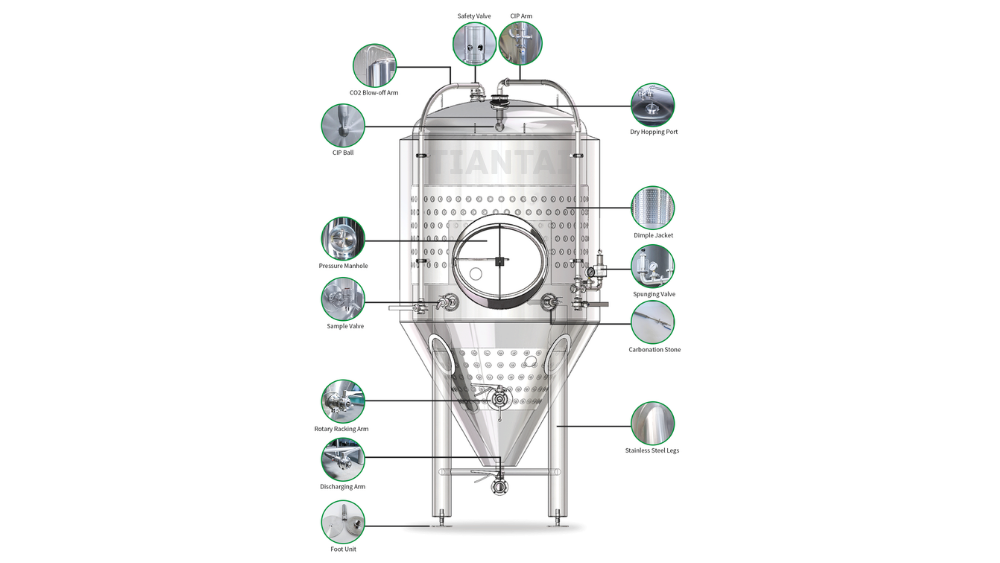
Tiantai fermentation systems are engineered with sanitary bottom outlets, optimized cone geometry, and adjustable racking arms that simplify yeast collection while maximizing beer recovery. Combined with hygienic piping layouts and fully drainable connections, these features help breweries maintain healthy yeast across repeated production cycles without increasing operator workload.
Why Tank Filling Strategy Affects Beer Quality
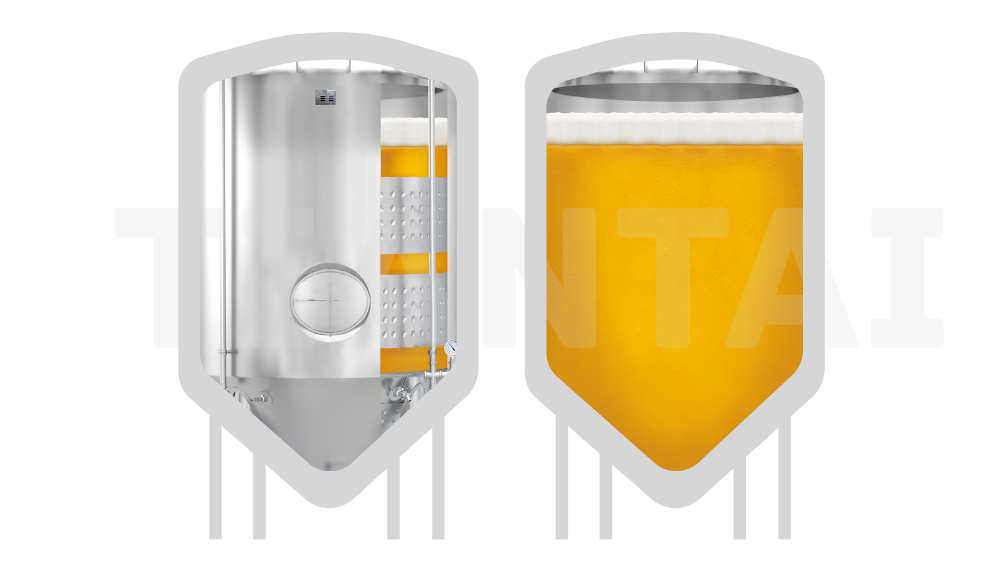
Another design consideration frequently overlooked during brewery planning is tank filling time. Many breweries naturally focus on fermentation temperature after filling is complete. However, fermentation does not wait for the final brew to enter the vessel. Once yeast is pitched into the first portion of wort, biological activity begins immediately.
If filling continues for many hours, later batches enter a vessel where fermentation has already started. This creates a different environment from the fresh wort that entered earlier.
- Carbon dioxide is already being produced.
- Heat generation has begun.
- Convection currents have developed.
- Hydrostatic pressure continues increasing as liquid depth rises.
The incoming wort therefore, experiences conditions that differ from those assumed during standard fermentation. Although this effect is often subtle, prolonged filling may influence several aspects of beer quality.
- Protein precipitation may occur more rapidly than intended.
- Flavor-active compounds develop under slightly different metabolic conditions.
- Diacetyl reduction may require additional conditioning time.
- Even yeast growth can vary because hydrostatic pressure increases continuously throughout the filling process.
None of these changes alone necessarily creates poor beer. Together, however, they contribute to increased batch-to-batch variation. For breweries producing consistent commercial brands, minimizing unnecessary process variation is a major objective.
Consequently, fermentation vessel size should never be determined independently of brewhouse capacity. A fermenter that requires an entire production day to fill may appear economical from an equipment perspective while reducing overall process consistency.
This illustrates one of the most important principles in brewery engineering:
Every major piece of equipment should be selected according to production workflow rather than individual capacity.
At Tiantai, fermentation cellar design begins with understanding how brewhouse output, cellar scheduling, cooling capacity, and future expansion plans interact. Matching these elements during project planning helps breweries achieve efficient filling schedules while maintaining stable fermentation performance over the long term.
Looking Ahead
Successful fermentation depends not only on how yeast settles, but also on how uniformly conditions are maintained throughout the entire vessel.
In Part 3, we will examine how hydrostatic pressure, internal circulation, and beer transfer strategy influence fermentation consistency, maturation, and flavor development inside modern commercial fermenters.