
Beer carbonation is an important step in commercial beer production. After fermentation and maturation, beer needs to be carefully controlled in terms of temperature, pressure, and CO₂ content to achieve the desired carbonation level. Proper carbonation helps ensure good foam formation, mouthfeel, and overall flavor.
For commercial breweries, carbonation is not simply a matter of adding CO₂ to beer. It also requires precise control of gas-liquid mass transfer and process stability to ensure consistent beer quality from batch to batch while minimizing CO₂ loss and excessive foaming. This article introduces the common carbonation methods used in commercial breweries, the key equipment involved, and the major factors that affect carbonation performance.
Why Does Beer Need Carbonation?
The CO₂ in beer mainly comes from yeast fermentation. However, the amount of CO₂ naturally retained in beer during fermentation is often not sufficient to meet the desired carbonation level for commercial products. Therefore, breweries usually adjust the CO₂ content during maturation or before packaging to achieve consistent product quality.
Proper carbonation provides several important benefits:
- Improves beer mouthfeel
- Enhances aroma release
- Balances the overall flavor
- Improves foam formation and stabil
Where Does the CO₂ in Beer Come From?
Commercial beer generally obtains CO₂ from two main sources:
CO₂ Produced During Fermentation
During primary fermentation, yeast converts fermentable sugars in the wort into alcohol and CO₂. Some of the CO₂ dissolves naturally into the beer, while the remaining CO₂ escapes from the fermentation vessel.
Externally Supplied CO₂
If the CO₂ level after fermentation is below the target value, the brewery can add food-grade CO₂ to precisely adjust the final carbonation level.
Therefore, commercial beer production may combine natural carbonation and forced carbonation to achieve a stable CO₂ level that meets the product specifications.
Common Beer Carbonation Methods Used in Breweries
Beer carbonation can generally be divided into natural carbonation and forced carbonation.
Natural carbonation relies on continued yeast fermentation to produce CO₂ and is commonly used for specific beer styles and processes such as bottle conditioning. Modern commercial breweries, however, more commonly use forced carbonation because it is faster, easier to control, and more suitable for maintaining consistency between batches.
Basic Process of Forced Beer Carbonation
1. Fermentation and Maturation
After primary fermentation is completed, the beer undergoes maturation, clarification, and stabilization. At this stage, the beer has developed its basic alcohol content and flavor profile, but its CO₂ level may not yet meet the requirements of the final product. Further carbonation adjustment may therefore be required.
2. Cooling the Beer
Before carbonation, the beer is cooled to an appropriate temperature. Lower beer temperatures generally improve CO₂ solubility, helping increase carbonation efficiency and reduce CO₂ loss.
3. Pressurized CO₂ Injection
The chilled beer enters a pressurized carbonation system, where food-grade CO₂ is introduced and brought into close contact with the beer through a dedicated carbonation device.
Compared with simply injecting CO₂ directly into a storage tank, an efficient gas-liquid mixing system can provide better mass transfer, improve CO₂ dissolution, and shorten the carbonation time.
4. CO₂ Dissolution
Under pressure, CO₂ gradually dissolves into the beer. By controlling the beer temperature, pressure, CO₂ flow rate, and contact time, breweries can promote efficient and uniform CO₂ dissolution.
5. Testing and Adjustment
After carbonation, the beer’s CO₂ content is measured and adjusted if necessary to reach the target value. This helps ensure that the final carbonation level meets product specifications and that the quality and mouthfeel remain consistent from batch to batch.
Key Factors Affecting Beer Carbonation
Beer Temperature
Lower temperatures generally increase the solubility of CO₂ in beer. Therefore, the beer temperature should be maintained within an appropriate and stable range during carbonation.
CO₂ Pressure
Proper pressure helps improve CO₂ dissolution efficiency. If the pressure is too low, carbonation may be insufficient. Excessively high pressure, on the other hand, may result in over-carbonation and excessive foaming during filling.
CO₂ Purity
Food-grade CO₂ that meets the requirements of food and beverage production should be used to avoid negatively affecting beer flavor and product safety.
Gas-Liquid Mass Transfer Efficiency
The contact area between CO₂ and beer, flow conditions, and contact time all affect carbonation efficiency. High-efficiency carbonation equipment can improve gas-liquid contact and promote rapid and uniform CO₂ dissolution.
What Equipment Is Required for Beer Carbonation?
In commercial breweries, the carbonation system is normally integrated with the fermentation, maturation, cooling, filtration, and packaging systems.
The main equipment includes:
Fermentation / Maturation Tanks
During fermentation and maturation, beer naturally produces and retains a certain amount of CO₂. Pressure-rated fermentation or maturation tanks can also help retain part of the naturally produced CO₂.
Beer Cooling System
A glycol cooling system or other suitable cooling method is used to reduce the beer temperature and create favorable conditions for CO₂ dissolution.
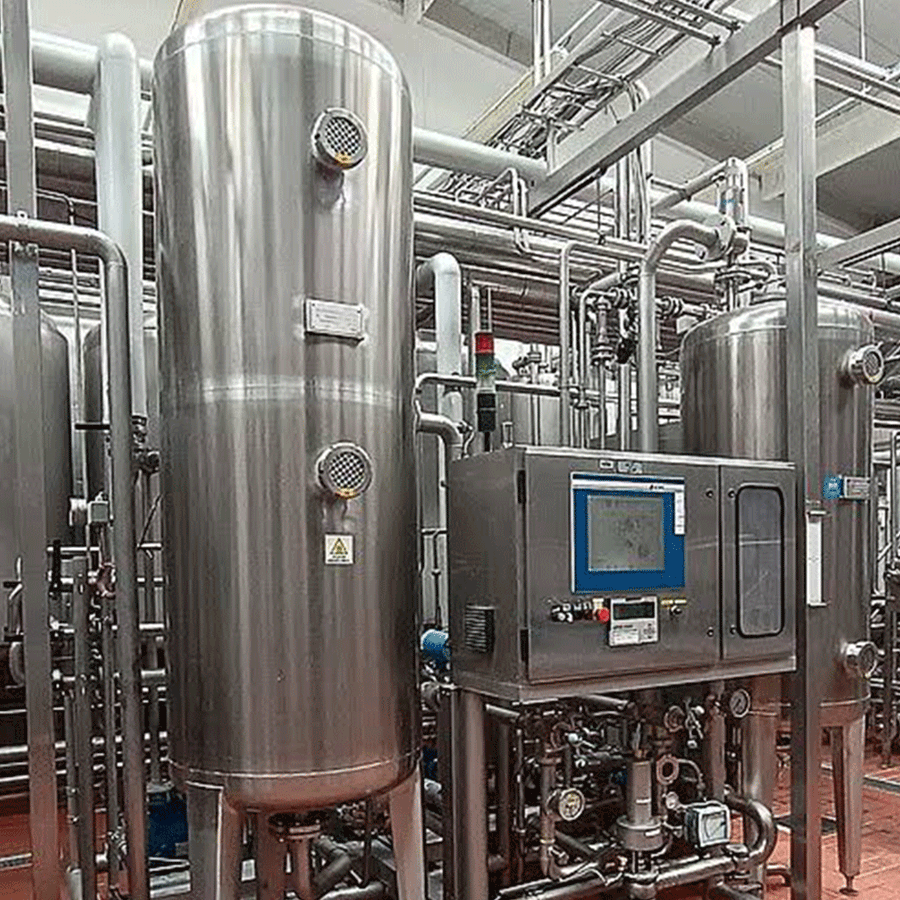
Beer Carbonation Equipment
This is one of the core components of a forced carbonation system. It is designed to promote efficient and uniform dissolution of food-grade CO₂ into the beer.
CO₂ Gas Supply System
The CO₂ supply system may include CO₂ storage, pressure reduction, filtration, pressure regulation, and delivery equipment. It provides a stable supply of food-grade CO₂ for the carbonation process.
Filtration Equipment
In some commercial beer production lines, carbonation can be appropriately integrated with final filtration and stabilization processes to produce a clearer and more stable finished beer.
Beer Filling Equipment
After carbonation, the beer needs to be packaged while minimizing CO₂ loss. Therefore, commercial breweries commonly use counter-pressure filling systems designed for carbonated beverages to reduce foaming and CO₂ loss during filling.
Beer carbonation is a comprehensive process involving the control of temperature, pressure, CO₂ supply, and gas-liquid mass transfer efficiency. For commercial breweries, the carbonation system should be properly integrated with the fermentation, maturation, cooling, filtration, CO₂ supply, and packaging systems. A well-designed carbonation system can not only improve production efficiency and CO₂ utilization but also help ensure consistent beer quality and carbonation levels from batch to batch.