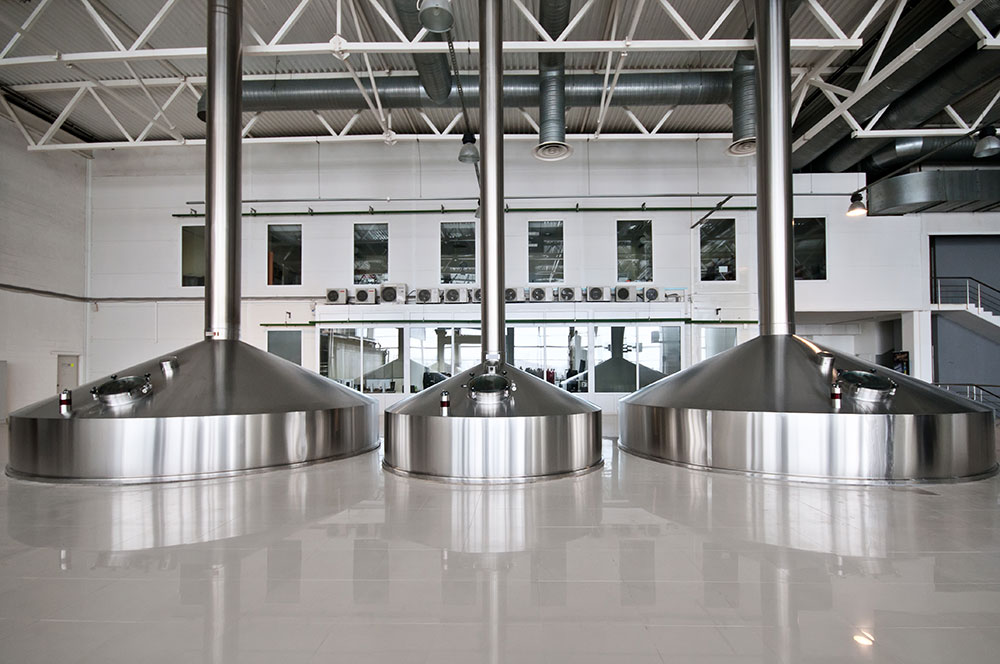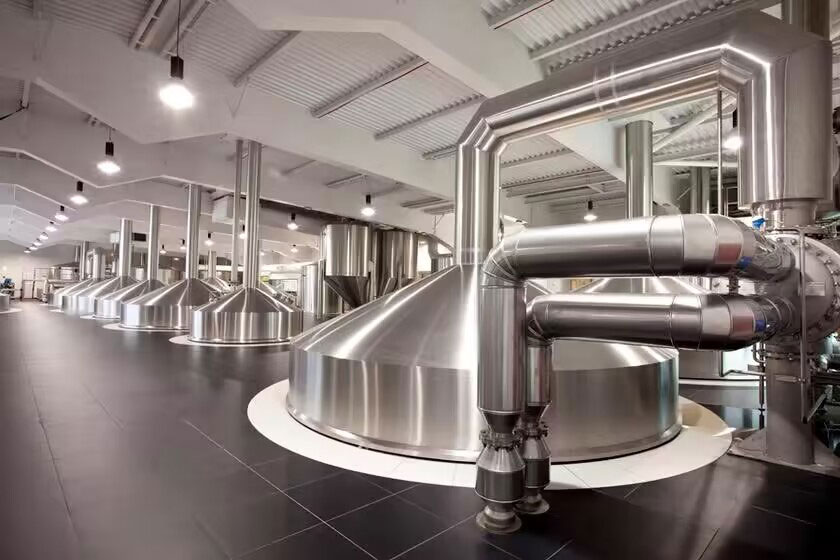

When planning a new brewery, investors often spend considerable time selecting brewhouse vessels, fermentation tanks, and filling equipment. The refrigeration system, however, deserves the same level of attention.
An undersized cooling system may struggle to maintain fermentation temperatures when several tanks operate simultaneously. An oversized system, on the other hand, may require unnecessary investment and operate inefficiently when production demand is low.
The challenge is to select refrigeration equipment that matches the brewery’s actual production schedule, cooling requirements, and future development plans.
Rather than choosing a chiller based only on brewhouse capacity, brewery planners should evaluate the entire production process before determining the required cooling capacity.
Start with the Brewery’s Production Schedule
The first step in planning a refrigeration system is understanding how the brewery will operate.
Two breweries with the same brewhouse capacity may have very different cooling requirements. The number of brewing batches per day, fermentation tank capacity, production frequency, and beer maturation time all influence the refrigeration load.
For example, a brewery producing several batches daily may transfer wort into fermentation tanks while other tanks are already in active fermentation. This creates overlapping cooling demand.
A useful planning exercise is to map the major production activities:
- Brewhouse operation and wort cooling.
- Fermentation across multiple tanks.
- Beer conditioning and maturation.
- Finished beer storage.
- Packaging-related cooling requirements.
The duration and frequency of each activity should be considered, not just the equipment’s nominal capacity.
A refrigeration system must be able to handle the busiest expected production period, rather than being designed around an average operating day.
Calculate Cooling Demand Across Different Processes
Different brewery operations generate or require cooling in different ways.
Wort cooling demand
Hot wort must be cooled from boiling or whirlpool temperatures to the appropriate yeast pitching temperature before fermentation.
The required cooling capacity depends on the wort volume per batch, initial and final temperatures, and the time available for cooling.
A brewery that needs to cool a large batch within a short transfer window may require a higher instantaneous cooling capacity than one operating at a slower production rate.
Fermentation cooling demand
Fermentation creates heat as yeast converts sugars into alcohol and carbon dioxide.
The amount of heat that must be removed changes throughout the fermentation cycle. Active fermentation generally creates a greater cooling requirement than later stages.
The number of fermentation tanks operating at the same time is therefore an important design factor.
The calculation should consider tank volume, fermentation schedule, beer type, temperature profile, and the expected overlap between fermentation cycles.
Conditioning and storage demand
Maturation and beer storage create another category of cooling demand.
Although these processes may not require the same cooling capacity as active fermentation, they can place a relatively continuous load on the холодильная установка.
The brewery’s total tank inventory and expected turnover rate should be included when estimating this demand.
Determine Whether Different Cooling Processes Need Separate Temperature Circuits
Not every brewery process requires the same cooling medium or supply temperature.
Using separate cooling circuits where appropriate can make temperature control easier and provide more flexibility.
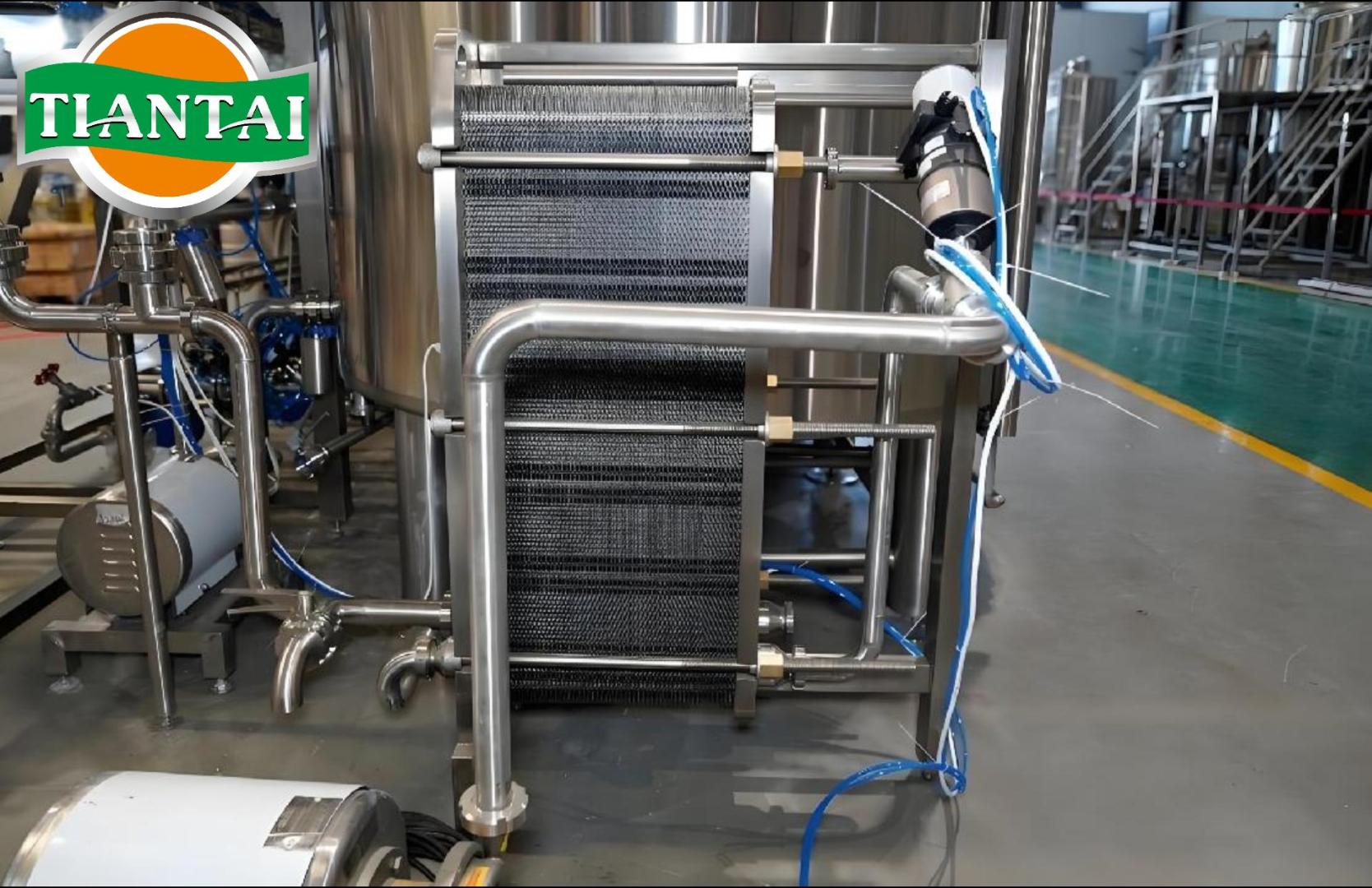
For example, cold water can be used in wort cooling, beer cooling during pasteurization, and other heat exchange applications.
A glycol circuit is commonly used for fermentation tank jackets, conditioning tanks, and other applications requiring controlled cooling.
In a typical arrangement, brewing water is cooled through a heat exchanger to prepare cold water. Glycol is used as the secondary refrigerant to remove heat from the water.
Using cold water in processes that directly contact wort, or where wort leakage could occur, also avoids introducing glycol into those product-contact applications.
The design should consider the required supply temperature, return temperature, heat exchanger capacity, and circulation requirements of each circuit.
Tiantai’s Cold Water Supply System is one example of a utility system that can be integrated into a brewery’s overall cooling configuration.

Consider Peak Demand, Not Just Total Cooling Capacity
One of the most common mistakes in refrigeration planning is adding together the maximum cooling requirements of every piece of equipment without considering when they actually operate.
In practice, different cooling loads have different operating schedules.
Wort cooling may require substantial capacity over a limited period. Fermentation cooling is distributed over longer periods, while beer storage creates a relatively steady demand.
The refrigeration design should therefore be based on the expected overlap between these processes.
A production schedule can help engineers identify the periods when several cooling operations occur simultaneously.
This also helps determine whether a single large refrigeration unit, multiple smaller units, or a staged refrigeration arrangement is more appropriate.
The objective is to provide sufficient capacity during peak demand without creating an unnecessarily large system for normal production.
Match the Refrigeration Plant to Site Conditions
The installation environment has a direct influence on refrigeration equipment selection.
Ambient temperature affects the холодильная установка‘s ability to reject heat. A system installed in a hot production environment may deliver less effective cooling capacity than the same equipment operating under milder conditions.
When preparing equipment specifications, consider:
- Maximum expected outdoor temperature.
- Indoor installation conditions and ventilation.
- Available cooling water, if required.
- Electrical supply and available power.
- Space for equipment installation and maintenance.
- The distance between the холодильная установка and cooling users.
The specified cooling capacity should reflect the actual operating conditions rather than relying solely on a chiller’s nominal rating.
This is particularly important for breweries operating in tropical or hot-climate regions.
Plan the Glycol Distribution Network
Selecting the refrigeration unit is only part of the design.
The cooled glycol must reach every connected tank and process equipment at the required flow rate and temperature.
An inadequately designed distribution network can create uneven cooling performance, even when the chiller itself has sufficient capacity.
The engineering layout should cover:
- Glycol circulation pump capacity.
- Main supply and return pipe dimensions.
- Branch connections to individual tanks.
- Control valves and temperature sensors.
- Insulation requirements.
- Access for inspection and future maintenance.
The glycol storage tank also plays an important role in system operation. It provides a buffer between refrigeration production and changing process demand.
Its capacity should be determined according to the system’s operating cycle and cooling requirements rather than selected independently.
Allow for Production Expansion
A brewery’s initial production capacity is not always its long-term target.
Some projects begin with a limited number of fermentation tanks and expand as sales increase. Others plan additional brewing batches or new packaging equipment as the business develops.
If future expansion is expected, it should be considered during the initial refrigeration design.
This does not necessarily mean purchasing all the additional cooling equipment at the beginning. A modular arrangement, appropriately sized distribution headers, and provisions for future connections may provide a more practical approach.
Planning for expansion early can also reduce the cost and disruption of modifying the utility system later.
Build a Brewery Cooling System Around the Entire Production Process
Refrigeration should not be treated as an isolated piece of equipment. Its capacity and distribution network need to match the way the brewery produces beer.
From wort cooling and fermentation to conditioning and packaging, each process contributes to the total cooling requirement.
Tiantai provides brewery equipment manufacturing and turnkey brewery project delivery, covering the brewhouse, fermentation system, cold water supply, холодильная установка, and other supporting utilities.
By considering production schedules, equipment configuration, and cooling demand together, the refrigeration system can be designed to support both current production and future expansion.
For investors planning a new brewery, coordinating these requirements during the initial engineering stage is an important step toward a reliable and economically practical production facility.